Report: 5.8 Million Knocks: A Three-Year Honeypot Record of SSH and Telnet Attacks
Scope, Data and Method
The report analyzes findings from one Cowrie SSH and Telnet honeypot between July 26, 2023 and October 31, 2026, a span of about 1,193 days. Geolocation and autonomous system (ASN) data come from MaxMind GeoLite2, and malware verdicts come from VirusTotal. IP address and domain reputation, shown under “Independent check,” comes from VirusTotal, AbuseIPDB, and URLhaus lookups. Network owner names were obtained from public web sources, including the Hurricane Electric border gateway protocol (BGP) toolkit.
Several terms are used consistently throughout the report.
- A scan is a connection that does not try to log in.
- An attack presents a username and password.
- A successful attack is one the honeypot accepts and gives a shell.
- An active attack goes on to run commands or malware, whereas a passive attack disconnects right after login.
Traffic Profile
The honeypot absorbed about 4,870 unsolicited connections a day, and roughly four in five were login attacks. Scans formed a steady background of about 1,046 a day. Other high-level indicators of unsolicited traffic are shown in Table 1.
| Measure | Value | Share or rate |
|---|---|---|
| Total unsolicited connections | 5,810,156 | About 4,870 per day |
| Scans | 1,247,416 | 21.5% of connections, about 1,046 per day |
| Attacks | 4,562,740 | 78.5% of connections, about 3,825 per day |
| Unique IP addresses (all traffic) | 232,086 | 25.0 connections per IP on average |
| Unique attacking IPs | 84,489 | 36.4% of all IPs, 54.0 attacks per IP on average |
| Unique ASNs | 11,200 | About 21 IPs per ASN |
| Countries of origin | 215 | Near-global coverage |
Two points stand out:
- First, at least 147,597 IPs (63.6% of all IPs) never attacked: subtracting the attacking IPs from the total leaves that many sources that only scanned.
- Second, the scale is wide but shallow. With 232,086 sources averaging about 25 connections each, the honeypot was touched by a very large, mostly low-volume population rather than by a handful of persistent actors.
Attack Funnel
Fewer than three in ten attacks (28.9%) went on to run commands or malware, but that still amounts to about 1,106 active attacks a day.
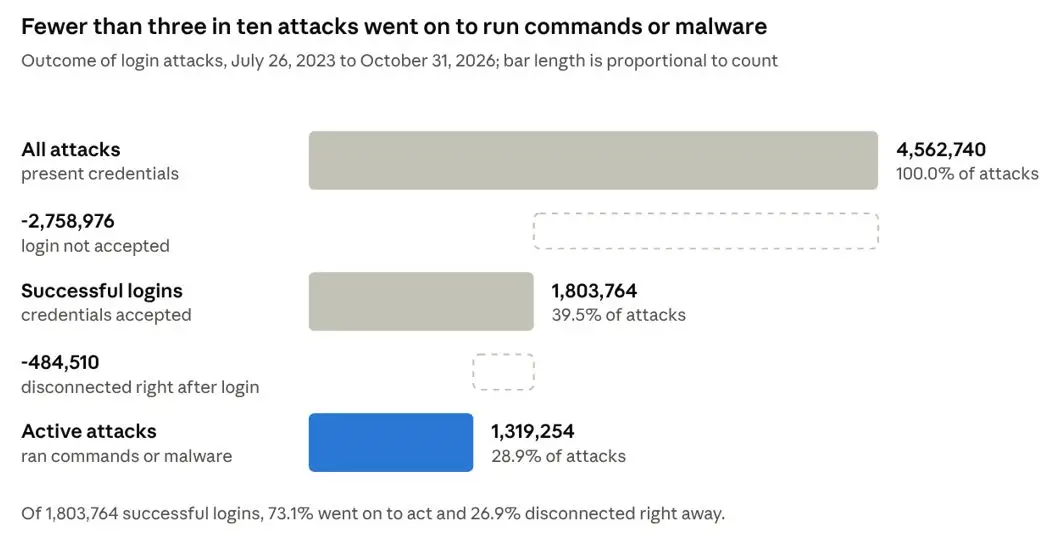
Figure 1. Attack funnel
As shown in Figure 1, attackers lose volume at two steps. The honeypot rejected 60.5% of attack sessions outright, and among the sessions that did get a shell, passive and active logins split roughly 1 to 2.7.
- Logging in is routine for a source. Of 84,489 attacking IPs, 67,704 (80.1%) logged in at least once, averaging about 26.6 successful attacks each.
- Active outnumbers passive. The 1,319,254 active attacks are 2.7 times the 484,510 passive ones, which means most logins are put to use immediately.
- Passive logins are a distinct pattern. A login that disconnects at once fits credential validation or access checking, common in reconnaissance.
The success rate depends on the honeypot’s acceptance policy, so these proportions describe the honeypot construction choices rather than real systems.
Report: 5.8 Million Knocks: A Three-Year Honeypot Record of SSH and Telnet Attacks
Leave a Reply